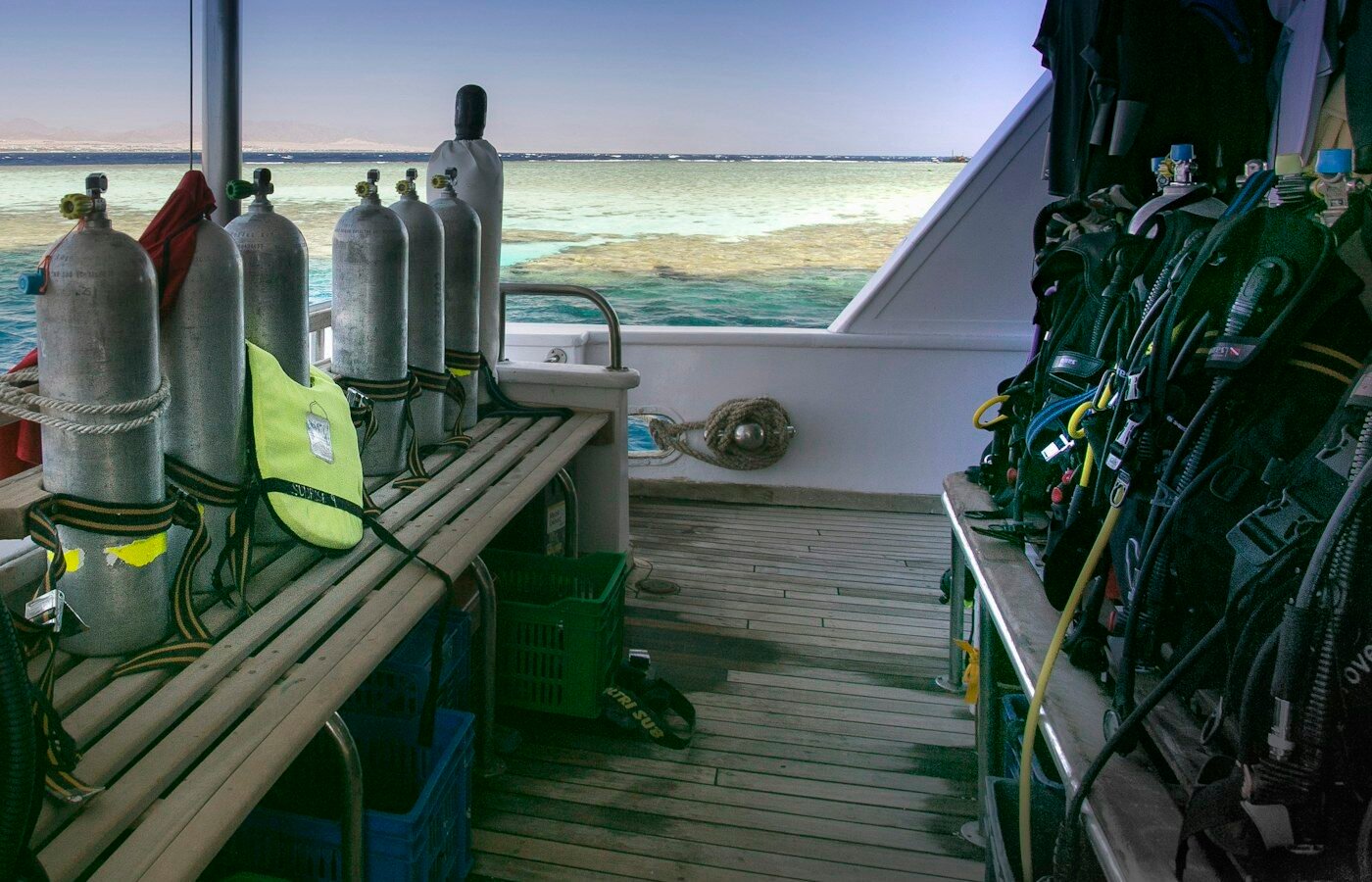
Long before the first diver rolls backward off the boat, a dive center has already put in a full working day. Someone has checked the morning’s bookings and chased two guests who still have not confirmed. The captain has studied the forecast and the fuel gauge. Cylinders have been filled, checked and loaded, and the regulators rinsed the night before are back on their hooks. The insurance renewal waits in a drawer, and a spreadsheet on a laptop holds the question every owner eventually asks: after all of that, how much money is actually left from this trip?
It sounds like a simple question, but it isn’t. Between the price a guest pays and what remains at the end of the day sit fuel, crew wages, booking commissions, permits, insurance, maintenance and equipment wear. There is also one factor nobody controls: how many days the sea, the weather and the market actually allow an operation to run. A full boat, it turns out, is not necessarily a profitable boat. Those differences shape the finances of Latin America’s dive centers, from family-run shops with a single skiff to large operators serving entire destinations.
This feature does not try to put a number on the industry’s profit margin. No sufficiently representative public dataset supports such a figure for the region, and inventing one would help nobody. Instead, it looks at the mechanics and the available evidence that explain why businesses that look almost identical from the dock can lead very different financial lives.
Cover photo: Claudia Salamone / Unsplash. Illustrative image.
An industry everyone sees but few have measured
Ask how big the dive business is in Latin America and the honest answer is that nobody knows precisely. There are pieces of the picture, but no complete portrait.
One of the most useful pieces comes from Mexico. A 2021 paper in Marine Policy estimated that diving and snorkeling there generated annual gross revenue of US$455 million to US$725 million, measured in 2019 dollars. The researchers compiled dive-site information and interviewed operators, and the lower estimate excludes large businesses. It is a valuable figure, but it needs careful reading. These are gross receipts, not profits. They describe one country, not the region, and they cannot be stretched into a 2026 market size for Latin America. Read the study.
The Datamares Dive Atlas maps dive sites alongside protected areas in Mexico. Seen on a map, the overlap tells its own business story: the reefs, walls and wildlife encounters customers pay for are not just scenery. They are the industry’s raw material.
Wider travel data points to momentum. UN Tourism reported that international arrivals in 2025 grew 7% in South America and 5% in Central America, compared with 1% across the Americas. That is encouraging for anyone selling experiences to visitors, but these are general tourism indicators, not a measure of demand for scuba diving. UN Tourism, January 2026.
Industry surveys exist too, though they are mostly shaped by the North American market. DEMA’s 2023 retail operations survey collected responses from more than 260 dive centers worldwide, and 79% of them were in the United States. It raises the right business questions, yet it is not a statistically representative picture of Latin American operators. DEMA research description.
Many ways to earn a living from the sea
Visitors tend to see one product: the guided boat trip, two tanks, back by lunchtime. Behind the counter, most dive centers are running several small businesses at once. They offer introductory experiences for nervous first-timers, certification courses and advanced training, and private charters for families or photographers. They also rent and sell equipment, repair it, fill cylinders, sell underwater photos and build partnerships with nearby hotels.
The mix matters because each product uses staff, boat space and capital in its own way. A private charter may command a premium price, but it ties up a vessel and a dedicated crew for a handful of people. A certification course draws on an instructor’s hours across several sessions, plus learning materials and certification fees. Retail means stock on the shelves, and that stock can lose value as models change. Rental gear earns money again and again, but only if someone cleans it, inspects it and eventually replaces it.
That is why judging these activities by sales alone can mislead. A month of strong turnover from heavily discounted courses may leave less behind than a quieter month of well-priced charters. The more revealing question is what each product contributes once the time, fuel and equipment it absorbs have been paid for.
Why a full boat does not guarantee a good day
The advertised price of a dive is only the start of the story. Some costs rise and fall with each departure or each guest. These include fuel, trip-based pay for guides and captains, site fees and permits, transport, consumables and commissions to resellers. When a guest books through an agency or a hotel desk, the price they see can differ substantially from the revenue that finally reaches the operator.
Then come the costs that don’t care whether the boat leaves the dock: rent, permanent payroll, administration, reservation systems, insurance, marketing, equipment servicing and depreciation. Cylinders need periodic testing and compressors need maintenance. Regulators and buoyancy compensators wear out on a schedule that has nothing to do with the booking calendar. A business that reports a profit but cannot afford to replace its compressor or survive a slow month has not really made money. It has borrowed from its own future.
This is where discounts become a double-edged sword. A center can fill every seat by cutting prices and still earn less from each diver than before. Another may take fewer people out, keep a healthier net price and make better use of its equipment. Occupancy alone cannot tell you whether a departure made financial sense. Only the money left after each guest’s real cost can do that, and those calculations should always rest on the company’s own verified figures rather than borrowed rules of thumb.
Before booking, divers can ask about group sizes, equipment condition and the operator’s safety procedures.
Living with the seasons
Every dive center knows its year by its rhythm. High-season receipts often have to carry the business through the quieter months, and the quiet months rarely arrive gently. Cancellations, weather closures, currency movements, access restrictions and thin forward bookings all add pressure at once. Payroll, rent and loan repayments do not disappear when departures are cancelled, which is why a cash reserve is not a luxury but a survival tool.
How guests arrive matters just as much. Direct bookings may deliver more revenue per diver, but they demand marketing effort and attentive customer service. Hotel referrals and travel distributors can bring steady volume in exchange for a commission. Neither channel is always the better one. The sensible choice depends on real acquisition costs, how many enquiries turn into bookings and how many guests come back.
There is no single Latin American model
A cenote operator who drives guests along jungle roads has a completely different cost base from an ocean operator running boats. An urban training school in a capital city has little in common with a remote island business that depends on a single flight connection. Labor rules, taxes, insurance products, banking costs, permits, financing and air connectivity all vary by country and destination. Any honest regional comparison has to state which business model and which sample it describes.
Growing without wearing out the reef
For a dive center, environmental management is not a side project. It belongs in the financial conversation. Reef degradation, crowded sites and poorly managed wildlife encounters erode the very product guests pay for, and they can bring tighter regulatory limits. A sustainable business depends on functioning ecosystems and on effective coordination among operators, local communities and authorities.
Growth, in other words, has a ceiling set by nature as much as by the market. Sometimes the wiser move is not adding another boat to an already busy site but raising the quality, and the price, of the experience. Our report on bull shark diving in Playa del Carmen examines how operating limits can shape an entire destination.
When instructors become business managers
Many dive center owners did not set out to run a company. They started as instructors and guides who loved the water, and one day found themselves negotiating with suppliers, reading tax notices and deciding whether to buy a new engine. The skills that make a great instructor, such as patience, calm and attention to detail, translate well. But the business side asks for a different kind of attention.
The owners who cope best tend to watch a handful of figures every month. They track net sales by product and what each trip contributes after its direct costs. They look at how full the boats really are, how many guests each guide handles, how often bookings are cancelled and what each sales channel takes in commission. They also keep an eye on maintenance reserves, advance bookings and, above all, available cash. None of this requires an accounting degree, just the habit of looking.
One discipline is easily overlooked: owners should account for their own labor separately from operating profit. If the owner works sixty hours a week without a salary, a business that appears profitable may simply be running on unpaid management work.
The gap between selling more and earning more is real. A Business of Diving Institute survey reviewing 2023 results and 2024 expectations found that revenue and profit movements did not always align. Its participants cannot establish a Latin American margin, but the distinction between sales growth and profit growth applies directly to the region. Survey results and scope.
More than taking tourists underwater
Behind every logbook stamp there is a payroll. Captains, divemasters, compressor mechanics, boat cleaners, receptionists and the families they support all depend on the economics described here. So do the small restaurants and guesthouses that fill up when divers come to town. When a dive center gets its numbers wrong, the consequences rarely stay inside the shop.
The challenge, then, is not simply to sell more dives. It is to price services realistically, operate safely, keep enough cash in reserve and protect the marine life on which customer demand depends. The strongest operator is not automatically the one running the most trips. It is the one that understands what each dive truly earns and can stay viable well beyond peak season.
Our report on bull shark diving in Playa del Carmen examines how operating limits affect a destination.