Editorial note (5 November 2026): this article was added to Diving LATAM today and filed under 4 November, the date of the reported event or original announcement. The archive date is not the actual publication date.
Job listings from a Brazilian offshore company offer a useful snapshot of the technical competencies employers are seeking in divers and supervisors. They do not, on their own, prove a sector-wide hiring boom.
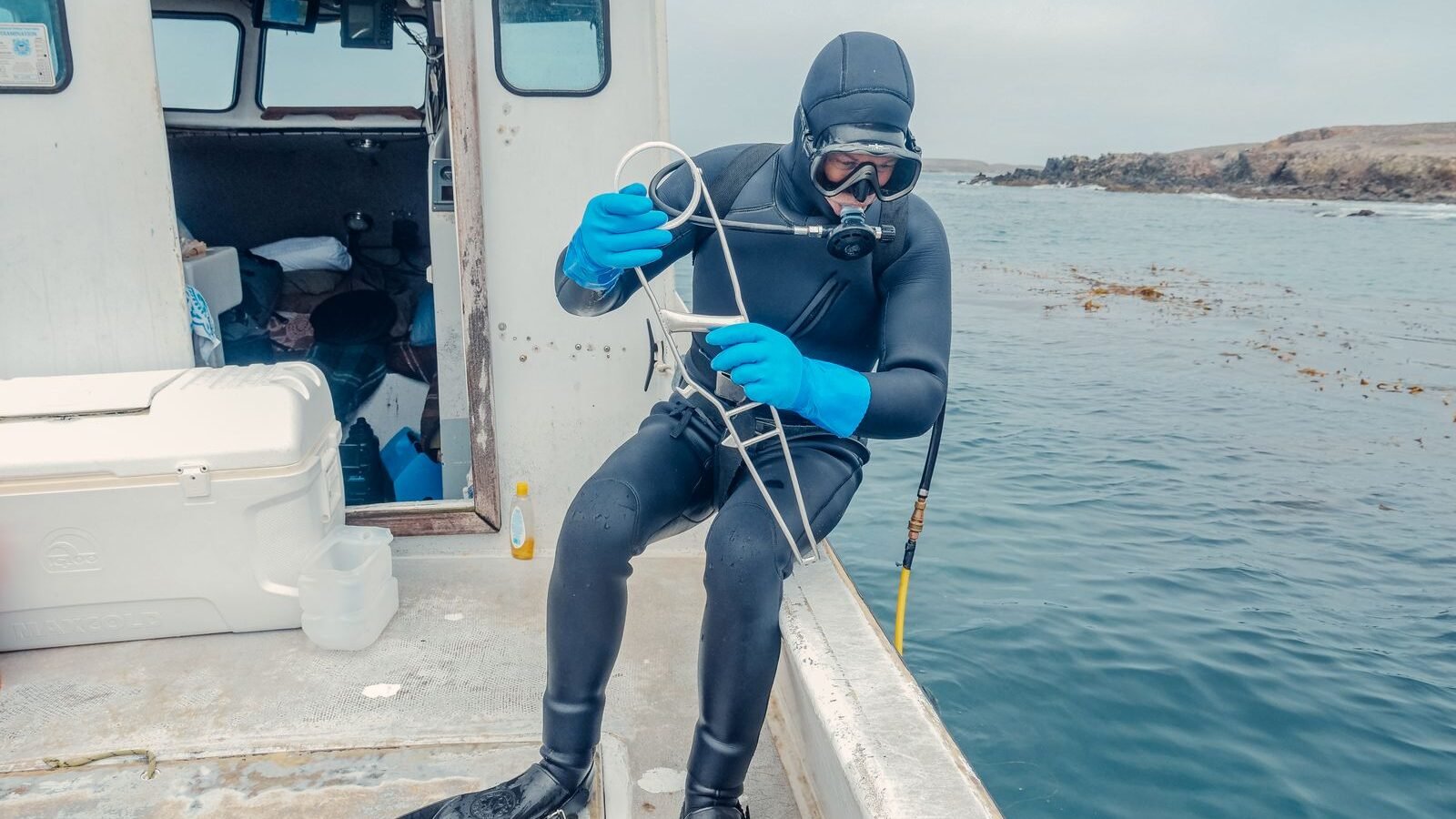
Brazil | Diving LATAM Newsroom. Illustrative archive photograph of dive-equipment preparation, not an Oceânica operation. Photo: Kindel Media / Pexels.
In an industry where training and documentation can determine employment options, a real job specification is more useful than a vague promise of an offshore career. On 4 November 2026, Brazilian publication Naval Porto Estaleiro counted 36 positions displayed on the recruitment platform of Oceânica, an underwater-services company linked to the energy sector. Seven involved shipboard work, including two Mergulhador Raso B diver positions and one diving supervisor position.
The timeline matters: the diver and supervisor jobs had been posted in September. November’s development was a fresh count of listings still displayed—not an announcement of 36 simultaneous new hires or a statistical indicator of industry-wide expansion.
What the underwater roles involve
The company’s official entry for Mergulhador Raso B lists mobilisation and demobilisation of diving systems, assembly and removal of underwater structures, visual inspection, cleaning, installation and replacement of submerged components. Other tasks may include magnetic-particle testing, wall-thickness measurement, cathodic-protection checks, photographic records and work with remotely operated devices, whenever the worker holds the relevant qualifications.
That qualification is crucial: inclusion on a responsibility list does not authorise every diver to perform the task. Non-destructive testing, industrial maintenance, underwater cutting and welding require specific competencies, approved procedures and competent supervision.
What applicants must demonstrate
The employer asks for commercial diving experience, a professional diver course, a valid Brazilian CIR maritime identity document, a diving logbook, CBSP and T-HUET training. Cutting and welding, assembly and maintenance, and medical-emergency courses are also listed; fluent English is desirable. The posted offshore rotation is 14 days on and 14 days off.
The supervisor specification shows why leading a dive team involves much more than diving skill: assessing whether work is feasible, carrying out preliminary risk analysis, checking gas supplies and diving systems, interpreting weather conditions, and organising emergency and rescue drills. These are risk-management functions, not simply advanced physical abilities.
Lessons for Latin American training providers
For prospective divers elsewhere in the region, the listings reveal potential gaps between a school’s curriculum and a real employer’s requirements: maritime documentation, offshore survival, helicopter underwater escape, recorded experience, industrial skills and technical communication. Qualifications from one country are not automatically valid in another. Training providers should verify both maritime-authority and contractor requirements in the destination jurisdiction before promising international career pathways.
Several qualifications often conflated in marketing must remain distinct: recreational dive instructor, commercial diver and offshore diving supervisor are not interchangeable credentials. Experience in dive tourism alone does not establish authorisation for industrial underwater work.
What the figures cannot tell us
The listing count provides no salary range, national workforce total or year-on-year hiring series. It also includes maritime and onshore technical positions unrelated to hands-on diving. Claims that Brazil suddenly needs thousands of divers or faces a nationwide shortage cannot be drawn from this sample.
The meaningful conclusion is narrower and more useful: specific employers seek people who can work within complex operations governed by documentation, supervision and ongoing training. That is a tangible reference for students, schools and underwater contractors throughout the region.