Editorial note (5 November 2026): this article was added to Diving LATAM today and filed under 4 November, the date of the reported event or original announcement. The archive date is not the actual publication date.
Mexico’s Navy intentionally sank the former ARM Baranda on 4 November off Juluapan, Manzanillo. The artificial reef project aims to support diving tourism, research and marine habitat. Its long-term success will depend on site management and measurable results.
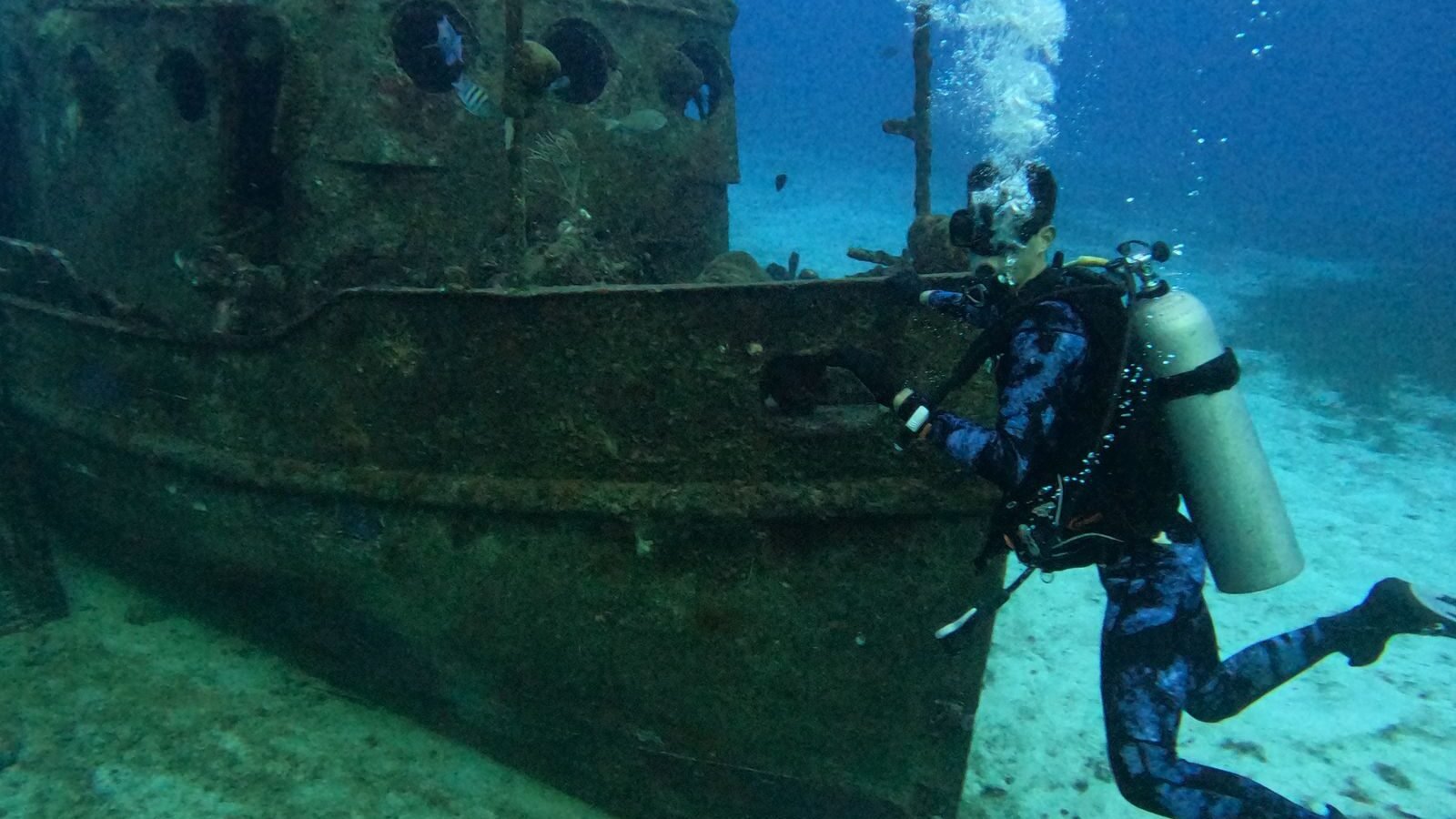
Manzanillo, Mexico | Diving LATAM Newsroom. Featured image is an archive photograph of a wreck in Cozumel, not the Baranda. Photo: Domingo Dias / Pexels.
A retired military vessel does not become a functioning reef the moment it reaches the seabed. That is the challenge now facing Santiago Bay, where the former ARM Baranda, following 45 years of service, joined the Colima Artificial Reef System (SAAC). The Mexican Navy confirmed the controlled sinking near Punta Juluapan on 4 November 2026. It is the second former vessel included in the project, after the Cora.
An environmental and tourism goal, not a proven outcome
According to the Colima government, the ship should provide attachment surfaces and refuge for marine organisms while diversifying Pacific coast diving attractions. Those are objectives, not evidence that ecological recovery has already occurred. Fish appearing around a new structure may simply be aggregating from surrounding habitats. Demonstrating additional biomass production or a net ecosystem benefit requires long-term observations and an appropriate study design.
The interagency committee preparing the operation included the Navy, port and environmental authorities, researchers from the Faculty of Marine Sciences and local dive operators. That cooperation matters: sinking the vessel is only the first part of a process involving environmental preparation, access management, recreational safety and scientific monitoring.
When will the site be ready for divers?
A new structure underwater does not mean a site is automatically open to the public. Operators need official coordinates, depth surveys, confirmation of hull stability, assessments of entanglement and sharp-object hazards, and seasonal reviews of currents and visibility. They also need mooring arrangements that prevent damage from anchors, group limits and workable diver-rescue procedures.
Local reporting suggested a depth of roughly 25 metres, which should be confirmed by a site survey before dive profiles are planned. Nor does the sinking announcement provide blanket permission for wreck penetration. Entering a structure involves training, equipment configuration, redundancy and risk controls distinct from viewing its exterior.
Environmental preparation needs transparent records
Ships destined for deliberate sinking require the removal or appropriate treatment of potentially polluting materials. AFmedios reported pre-sinking checks covering fuel, lubricants, batteries and hazardous waste. The underlying environmental documents and subsequent sampling results should be available for public scrutiny.
As a technical reference—not a Mexican certification for this vessel—the US Environmental Protection Agency publishes guidance for preparing ships to become artificial reefs. The appropriate editorial question is which controls were actually implemented for the Baranda, rather than assuming compliance by analogy.
What Manzanillo stands to gain
A properly managed wreck can support dive trips, specialty training, boat services and longer visitor stays. Yet local economic value is not just a question of visitor numbers. Access rules, carrying capacity, participation by local operators and reliable funding for surveillance and monitoring matter as well.
For Latin America, the project raises a transferable question: how can retired naval infrastructure create tourist value without describing an unmeasured intervention as ecological restoration? Answers will require bathymetric data, biological baselines, safety procedures and multi-year follow-up.